| Top Page |
| Freq |
| Tigers Football |
| Broadband news |
| Photos |
| Videos |
| old motel |
| Goat Castle |
| Hog Dog Trials |
| Forest Festival |
| ATV Trail |
| Salt Mine Bomb |
| Railroad |
| WB |
| cats |
| Station info |
| L&A |
| Louisiana Midland |
| Rock Island |
| Tremount Railroad |
| Rail Cars |
| LR&N |
| Southern Belle |
| Unknown |
| Weather Stations |
| Off Site Links |
| Weather Software |
| Winn Parish Enterprise |
| Huey Long |
| The Piney Woods |
| Forest site |
| LA Mule UTV |
| Rochelle |
| Farmall site |
| Melton Cemetery |
| Cenla Cat Project |
| Winn index |

Tremount & Gulf Railroad
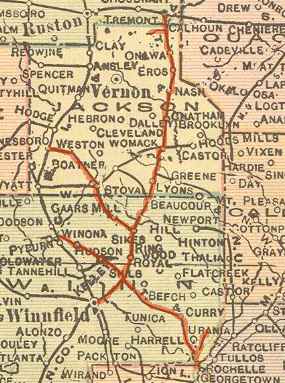
The Tremont & Gulf Railway Company began around 1904, as a logging railroad in conjunction with Tremont Lumber Company
at Tremont, Louisiana. The railroad ran to Eros, Chatum Winnfield and Rochele connecting the Tremount owned mills.
On September 19, 1907 the Tremont & Gulf rolled its first train into Winnfield. Instead of using the telegraph,
the railroad was operated by a telephone switchboard from the train dispatcher's office in Winnfield.
The various lines serving Winnfield had 12 passenger trains and 8 freight trains running into Winnfield daily.
The Tremont & Gulf had 71 miles of track in 1936, connecting with the Missouri Pacific at Rochelle,
Illinois Central at Tremont, O N & W at Gulf Crossing, and Louisiana & Arkansas and Rock Island in Winnfield.
It had 100 employees and a $150,000 payroll.
Every morning at one-hour intervals beginning at 6:30 the three trains rolled out of Winnfield yards: one a solid
freight which runs to West Monroe 40 miles away and return; a mixed freight and passenger on schedule between
Winnfield and Tremont where it connects with the Yazoo & Mississipi Valley branch of the Illinois Central; and
another freight with passenger accommodations in its spacious caboose on the 20-mile run to Waggoner, where it
connects with both the Rock Island and the Louisiana & Arkansas.
The line also included an extension into West Monroe from Chatham. The T&G was purchased by Illinois Central on November 15, 1958.
The line was abandoned by Illinois Central Gulf Railroad on March 1, 1986.
One rail car still sets on the side of the road at Chatham, LA
At least three branches built by Tremont Lumber to Daily, Alger, and Bennett were all abandoned by 1909.
The 20-mile Jonesboro branch (known as the Shreveport, Jonesboro & Natchez R. R.) was begun in 1906 and operated
until shortly after the Jonesboro sawmill cut its last log on August 12, 1915.
The main shops were removed from Eros to Winnfield in 1918. The Eros sawmill closed in 1926. T&G's mileage
dropped from 98.5 miles in 1915 to 66.6 by 1920. The following is a observation by an unknown author:
"The train passed by one morning; I saw it go out. When it came back it was pulling up the tracks and ties
and loading them on the flat cars the engine was pulling. Soon the train was out of sight and the railroad was
gone".
It looks from records in the "Tap Line Case" that Tremount got in to legal troubles because the railroad was not charging the mill for usage and the railroad was to be a common carrier not connected to the mill. The railroad also did not own the spurs that made connections to the other railroads the mills owned those and the rates being charged the other railrodas may have been unlawful. See Summary of Tremont & Gulf Railway "Tap Line Case" Changes were made in rates charged and seperate boards of directors were setup to make the Tremount railroad seperate from the Tremount Mills.
Copyright 2026 by winnfreenet all rights reserved.
 V7.2 (c)2020
 (Visits since 7-2010 172842)